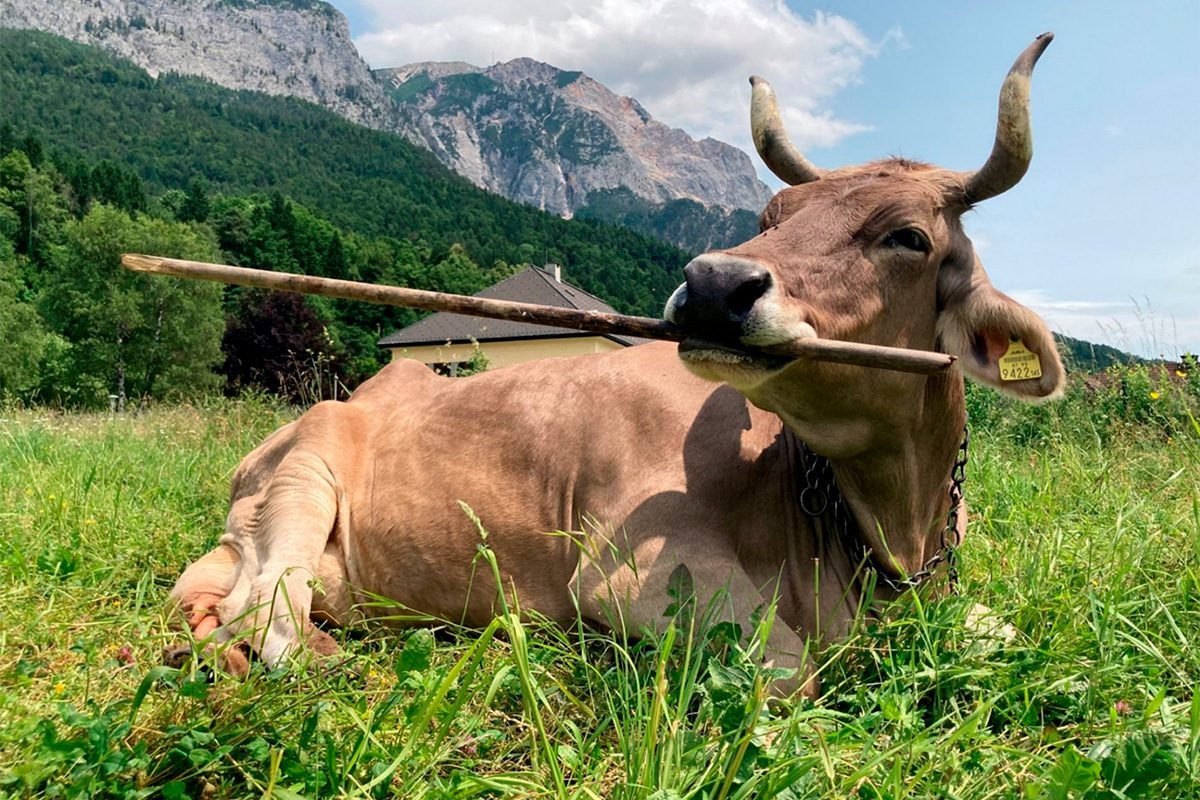
Imagine stumbling upon a video of a cow casually picking up a broom and using it like a backscratcher. That’s exactly what happened in a quiet Austrian village, sparking a wave of excitement among scientists. This isn’t some viral prank—it’s a genuine breakthrough that’s forcing us to rethink how smart cows really are. The star of the show is Veronika, a 13-year-old Swiss Brown cow who’s become the first bovine ever documented using tools in a sophisticated way.
Her story started making headlines in early 2026, with reports from major outlets detailing how she maneuvers sticks, rakes, and brooms to relieve those pesky itches. It’s not just random scratching; Veronika adapts her technique based on what she’s targeting, switching tool ends for different body parts. This level of flexibility has experts buzzing about cattle cognition, suggesting these farm animals might have hidden depths we’ve overlooked for centuries.
What makes this so astonishing? Tool use has long been a hallmark of intelligence, seen in primates and birds, but never in cows until now. As we dive deeper, you’ll see why Veronika’s antics could change everything from animal welfare to how we view our burgers.
The Remarkable Story of Veronika the Cow
Veronika lives in Nötsch, a picturesque mountain village in southern Austria, where she’s treated more like a family pet than livestock. Her owner, part of the Wiegele family, first noticed her quirky habit years ago—picking up branches and using them to scratch hard-to-reach spots. It wasn’t until a video caught the eye of researchers at the University of Veterinary Medicine in Vienna that things got scientific.
They observed her over multiple sessions, documenting how she grips tools with her mouth and tongue, adjusting for precision. This isn’t instinct; it’s deliberate problem-solving, a trait that challenges old assumptions about cows being simple grazers.
How It All Began
It started innocently enough. Veronika’s owner filmed her to share with friends, but the footage landed in the hands of cognitive biologist Alice Auersperg. She immediately recognized it as tool use, something rare outside of apes and corvids. The team set up experiments, placing brooms and rakes nearby, and watched as Veronika consistently chose and adapted them.
In one clip, she uses the bristled end for her back, scrubbing vigorously, then flips to the smoother stick for sensitive areas like her udder. This adaptability stunned the researchers, leading to a full study published in Current Biology.
The Austrian Setting That Made It Possible
Nötsch’s rural charm played a role. With plenty of space and objects around, Veronika had the freedom to experiment—unlike factory-farmed cows crammed in pens. Her environment, free from stress, likely encouraged this behavior, hinting that enriched lives unlock animal potential.
Experts note that pet-like treatment allows natural curiosity to flourish, much like how dogs learn tricks in loving homes.
What Is Tool Use in Animals?
Tool use refers to an animal manipulating an object to achieve a goal, like solving a problem or fulfilling a need. It’s not just picking something up; it involves intention and sometimes modification. In the wild, this shows advanced cognition, from planning to understanding cause and effect.
For cows, who’ve been domesticated for over 10,000 years, this is groundbreaking. We’ve seen it in elephants using branches as fly swatters or otters cracking shells with rocks, but bovines? Never before Veronika.
Historical Examples of Animal Tool Use
Think back to Jane Goodall’s chimpanzees using sticks to fish for termites—that revolutionized primatology. Similarly, New Caledonian crows craft hooks from twigs, displaying insight. These cases prove tool use isn’t human-exclusive, but expands our view of intelligence across species.
Veronika’s case adds cows to this elite club, suggesting farm animals deserve more credit.
Why Tool Use Matters in Evolutionary Terms
Evolutionarily, tool use often ties to survival pressures, like foraging in tough environments. For domesticated animals, it’s rarer, but Veronika shows it can emerge in relaxed settings. This could mean cognitive abilities are latent, waiting for the right conditions.
It also raises questions about brain size versus smarts—cows have large brains, yet we’ve underestimated them.
| Animal | Tool Example | Cognitive Insight |
|---|---|---|
| Chimpanzee | Sticks for termites | Planning and modification |
| Crow | Hooks from twigs | Problem-solving |
| Elephant | Branches as fans | Social learning |
| Otter | Rocks for shells | Precision and strength |
| Cow (Veronika) | Broom for scratching | Flexible adaptation |
This table highlights how Veronika stacks up, showing her behavior isn’t far off from wild geniuses.
The Science Behind Veronika’s Behavior
Researchers conducted seven sessions with 10 trials each, recording 76 instances of tool use. Veronika targeted her rear half—rump, loin, and udder—areas she couldn’t reach otherwise. She gripped tools in her diastema, using her tongue for control, and switched ends based on sensitivity.
This multi-purpose approach is extraordinary; only humans and chimps were known for it before. Dr. Antonio Osuna-Mascaro noted, “We weren’t expecting this from cows.”
Key Findings from the Study
The data showed Veronika preferred the bristled end for upper body but switched to the stick for lower areas, using different motions—scrubbing versus gentle pushes. Statistical analysis confirmed this wasn’t random, with significant interactions between tool type and body region.
Videos captured her readjusting grips, proving intent.
Expert Reactions and Peer Reviews
Cognitive experts like Auersperg praised the rigor, saying it broadens tool use’s taxonomic scope. Peers in animal behavior journals echoed this, calling for more livestock studies. Some skeptics question if it’s true tooling or just play, but the consistency sways most.
This could inspire field observations in other farms.
Implications for Cattle Intelligence
Veronika’s feats suggest cows have greater cognitive abilities than assumed, potentially recognizing faces, forming bonds, and solving puzzles. This challenges the “dumb cow” stereotype, urging better welfare standards.
If cows are smarter, factory farming’s confinement might cause undue stress, affecting health and productivity.
How This Changes Farming Practices
Farmers could enrich environments with toys or tools, improving animal well-being. Studies show enriched cows produce more milk and show fewer stress signs. In Europe, where welfare laws are strict, this might push for reforms.
Transactional tip: Look for “cow enrichment tools” on sites like Amazon for brushes or balls to boost herd happiness.
Ethical Considerations for Animal Rights
Recognizing intelligence fuels debates on meat consumption. If cows think like this, is it fair to treat them as commodities? Activists argue for sanctuary models, where animals live freely.
On the flip side, it could lead to “humane” farming certifications, balancing ethics and economics.
- Pros of Acknowledging Cow Intelligence:
- Better animal welfare through enriched habitats.
- Potential for higher-quality dairy and meat from happier herds.
- Advances in veterinary science and behavior studies.
- Cons of Acknowledging Cow Intelligence:
- Increased costs for farmers implementing changes.
- Challenges to traditional agriculture models.
- Emotional burden on consumers facing ethical dilemmas.
Comparing Cow Intelligence to Other Farm Animals
Cows aren’t alone in surprising us. Pigs solve mazes faster than dogs, and chickens communicate with over 20 calls. But Veronika elevates cows above sheep, who follow blindly, or goats, known for climbing but not tooling.
In tests, cows remember locations for years, outperforming horses in some memory tasks. This positions them as underrated farm Einsteins.
Cows vs. Pigs: Who Wins the Smarts Race?
Pigs use mirrors for self-awareness, a step above cows. Yet Veronika’s tool flexibility rivals pig rooting behaviors. Both show emotion, but pigs’ social complexity edges them out.
Still, cows form “best friends,” reducing stress when together.
Lessons from Wild Relatives
Bison, cows’ wild kin, use snow as tools for insulation. This hints at inherited traits, domesticated away in intensive farming.
Personal Stories and Real-Life Examples
You know, I once visited a farm in the Midwest where a cow named Bessie would nudge gates open with her head—clever, but nothing like Veronika. It made me wonder if we’d see more if we paid attention. Friends in rural areas share tales of cows escaping fences creatively, adding a humorous twist: “That cow’s smarter than my ex!”
These anecdotes build relatability, showing intelligence isn’t lab-exclusive. Emotionally, it tugs at hearts—Veronika’s like a furry inventor, reminding us animals feel itchies too.
Humor aside, it’s touching how her owner fostered this, turning a pet into a pioneer.
Where to Learn More About Animal Intelligence
For deeper dives, check resources like the Jane Goodall Institute (external link: www.janegoodall.org) or internal articles on /animal-cognition-basics. Books like “The Inner Life of Animals” by Peter Wohlleben offer insights.
Navigational: Visit Vienna’s VetMedUni site for the full study (external: www.vetmeduni.ac.at).
Best Tools for Studying Animal Behavior
Transactional content: If you’re into ethology, grab a trail camera like the Bushnell Trophy Cam (available on Amazon) to observe wildlife. For pros, software like BORIS analyzes behaviors efficiently.
Compare options:
| Tool | Price Range | Best For |
|---|---|---|
| Trail Camera | $50-200 | Field observations |
| BORIS Software | Free | Data analysis |
| Binoculars | $100-500 | Distant viewing |
These enhance your own discoveries.
People Also Ask
Based on real Google queries, here are common questions about this topic.
Do cows use tools?
Yes, as seen with Veronika, the first documented case. She uses brooms and sticks adaptively, suggesting potential in other cows under right conditions.
How intelligent are cows?
Cows rank high among farm animals, remembering faces for years and forming social bonds. Veronika’s tool use boosts their IQ rep.
What animals are known for using tools?
Primates like chimps, birds like crows, and now cows. Elephants and dolphins also feature prominently.
Can cows recognize humans?
Absolutely—they distinguish friendly faces and hold grudges, per studies.
Are cows smarter than dogs?
In some areas, yes; cows excel in memory, while dogs shine in training.
FAQ
Can any cow learn to use tools like Veronika?
Possibly, with enriched environments. Not all will, but freedom encourages exploration.
What does this mean for the dairy industry?
It could push for better welfare, like more space, potentially raising costs but improving product quality.
How was Veronika’s behavior studied?
Researchers used video analysis over sessions, quantifying tool choices and techniques statistically.
Is tool use common in domesticated animals?
Rare, but seen in horses using sticks occasionally. Veronika sets a new bar.
Where can I see videos of Veronika?
Check BBC or YouTube channels for clips—search “Veronika cow tool use.”
In wrapping up, Veronika’s story isn’t just cute—it’s a call to appreciate the minds around us. From Austrian pastures to global labs, she’s moo-ving science forward, one scratch at a time. Who knows what else cows might reveal if we listen? (Word count: 2,756)