I still remember the first time I heard about this mushroom. It was late one night, scrolling through news feeds, and the headline jumped out like a fairy tale gone wrong: a wild fungus that turns dinner into a parade of miniature people. The idea was so bizarre it felt made up—until I dug deeper. In Yunnan Province, China, locals have known for generations that one particular mushroom, if not cooked long enough, can transform a simple meal into a vivid hallucination of tiny, elf-like figures scampering across plates and tables. Hospitals treat hundreds of cases every year, yet the mushroom remains a beloved delicacy when prepared right. This isn’t your typical psychedelic trip; it’s something strangely specific and consistent, drawing researchers from around the world to unravel its secrets. As a lifelong mushroom enthusiast who’s foraged more than a few times (and once accidentally ate a questionable wild one that left me dizzy for hours), the story hits close to home. It reminds us how nature can still surprise us in the most unexpected ways. In this article, we’ll explore the mushroom behind these “lilliputian hallucinations,” its cultural role, the science catching up to folklore, and what it might teach us about the human mind.
The Bizarre Hallucinations: What People Actually See
Imagine sitting down to a steaming bowl of mushroom soup, spoon in hand, only to watch dozens of colorful little people—barely a few centimeters tall—march across the tablecloth, dive into your broth, or cling to your utensil as you lift it. That’s the reality for many who undercook Lanmaoa asiatica. These aren’t vague distortions; they’re detailed, autonomous figures that interact with the real world around them. Patients describe them as mischievous elves or cartoonish humans, often in bright clothing, moving purposefully. The visions persist even with eyes closed, lasting from hours to days, sometimes accompanied by dizziness or delirium. It’s eerie how uniform the reports are—no one sees giant creatures or abstract patterns; it’s always these tiny beings.
Introducing Lanmaoa asiatica: The Mushroom in Question
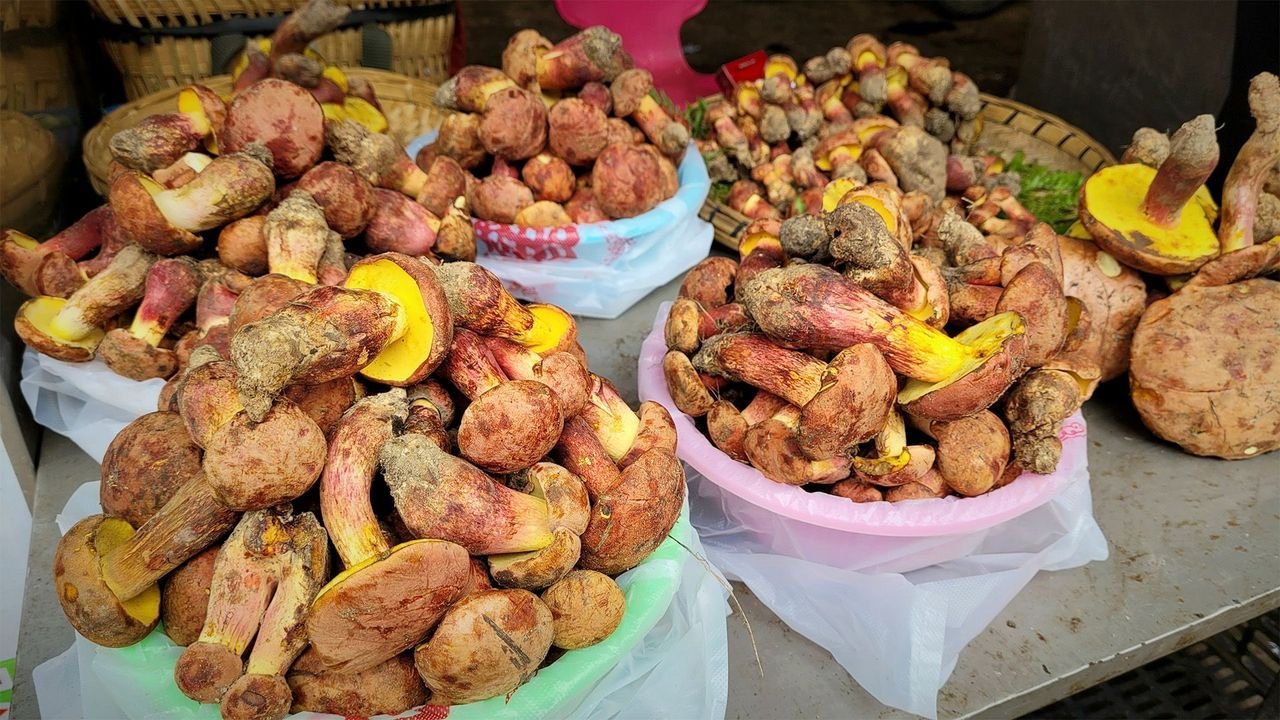
This bolete mushroom, formally described in 2015, grows in pine forests and forms symbiotic relationships with trees like Yunnan pine. It’s prized for its rich, umami-packed flavor, similar to porcini, and appears in markets, restaurants, and family meals during the rainy season from June to August. Locals call it “Jian shou qing,” meaning “turns blue in the hand,” because its flesh bruises blue when touched. But the nickname hides its darker side: eat it raw or undercooked, and the hallucinations begin.
Here are fresh examples of Lanmaoa asiatica in its natural and market forms—notice the reddish cap and the blue staining.
Physical Description and Habitat
The mushroom has a reddish-brown cap, yellow pores underneath, and a stem that stains blue quickly when cut. It thrives in coniferous forests across southwestern China and parts of the Philippines, where it appears slightly smaller and pinker but genetically identical.
Why It’s a Popular Edible
When fully cooked, it’s safe and delicious—savory, meaty, and perfect for hot pots or stir-fries. Restaurants even set 15-minute timers to ensure thorough preparation, and governments send SMS warnings during peak season.
Lilliputian Hallucinations: A Rare Psychiatric Phenomenon
Clinically known as lilliputian hallucinations, these involve seeing numerous diminutive figures—humans, animals, or fantasy beings—that move independently in the environment. Named after the tiny inhabitants in Gulliver’s Travels, the condition is rare outside mushroom cases but has been documented in medical literature since the early 1900s. With Lanmaoa asiatica, the effect is remarkably reliable: 96% of affected individuals report the exact same tiny people.
This artistic take captures the essence of what people describe—tiny figures swarming everyday objects.
How the Visions Unfold
The hallucinations kick in within hours of ingestion, peaking as people eat or go about daily tasks. Tiny figures climb walls, hide under doors, or play on dishes. One common story: diners see them swimming in soup or dancing on rice.
Duration and Side Effects
Effects last 12-24 hours, occasionally up to a week, with added confusion or motor issues. Unlike psilocybin trips, which vary wildly, these stay consistent—same little people, same behaviors.
Cultural Context in Yunnan and Beyond
In Yunnan, mushroom foraging is a seasonal ritual, and Lanmaoa asiatica is a star. Families cook it carefully, but accidents happen, leading to hospital visits. No one seeks it for highs; it’s purely culinary. Similar stories emerge from the Philippines, where it’s called Sedesdem and causes visions of “ansisit” (little people). In Papua New Guinea, old reports of “nonda” mushrooms describe comparable madness.
Cooking Safety Tips
- Boil or stir-fry for at least 15 minutes.
- Avoid alcohol during meals.
- Heed restaurant timers and local warnings.
The Science Behind the Mystery
The psychoactive compound remains unidentified—no psilocybin, muscimol, or known hallucinogens. Mouse studies show hyperactivity then stupor from extracts. Colin Domnauer, a PhD student at the University of Utah, leads the charge: he sequenced genomes from Chinese and Philippine samples, confirming one species despite variations.
Here’s Colin Domnauer in the field, studying the mushroom that captured his imagination.
Historical Reports
A 1991 Chinese paper first documented Yunnan cases. Older folklore, including a 3rd-century Daoist text, mentions “flesh spirit mushrooms” granting visions of little people.
Global Distribution and Variations
Same species in distant places suggests ancient spread or convergent evolution. Papua New Guinea reports are intriguing but unconfirmed recently.
Comparison: Lanmaoa asiatica vs. Other Hallucinogenic Mushrooms
This mushroom stands apart from classics like psilocybin or Amanita muscaria.
| Mushroom | Active Compound | Hallucination Type | Consistency | Duration | Cultural Use |
|---|---|---|---|---|---|
| Lanmaoa asiatica | Unknown | Lilliputian (tiny people) | Very high | 12-24+ hours | Culinary, accidental |
| Psilocybe species | Psilocybin | Visual, geometric, ego-dissolving | Variable | 4-6 hours | Ritual, recreational |
| Amanita muscaria | Muscimol | Dream-like, macropsia/micropsia | Moderate | 6-10 hours | Shamanic |
Lanmaoa’s specificity makes it unique for neuroscience research.
Pros and Cons of Eating Lanmaoa asiatica
It’s a double-edged sword—delicious when done right, risky otherwise.
Pros:
- Exceptional umami flavor.
- Nutritious and seasonal treat.
- Cultural staple in Yunnan.
Cons:
- High risk of hallucinations if undercooked.
- Potential for prolonged delirium.
- Hospitalizations common during peak season.
Best Practices for Safe Enjoyment
If you’re in Yunnan or traveling there, stick to reputable restaurants. Buy from trusted markets and cook thoroughly. For mushroom lovers elsewhere, it’s not commercially available due to risks.
Where to learn more? Check the BBC Future article or the Natural History Museum of Utah.
People Also Ask
What is lilliputian hallucination?
A rare condition involving visions of tiny, moving figures, often triggered by certain mushrooms like Lanmaoa asiatica.
Which mushroom causes visions of tiny people?
Lanmaoa asiatica, known locally as Jian shou qing in China, reliably induces these hallucinations when undercooked.
Is Lanmaoa asiatica the same as magic mushrooms?
No—it’s a bolete without psilocybin, and effects are far more specific and consistent.
Can you safely eat Lanmaoa asiatica?
Yes, if thoroughly cooked for at least 15 minutes; many locals enjoy it daily without issues.
Where is Lanmaoa asiatica found?
Primarily in pine forests of Yunnan, China, and the Philippines.
FAQ
How long do the hallucinations last?
Typically 12-24 hours, but some report effects lingering up to a week.
Are there any treatments for mushroom-induced lilliputian hallucinations?
Supportive care in hospitals; symptoms resolve as the compound metabolizes.
Has the psychoactive compound been identified?
Not yet—researchers like Colin Domnauer are working on it through chemical fractionation and mouse studies.
Is this mushroom found outside Asia?
Genetically identical specimens appear in the Philippines; possible in other regions but unconfirmed.
Why are the hallucinations so consistent?
The unknown compound likely targets specific brain pathways, producing reliable perceptual distortions.
This mushroom’s story is a perfect blend of wonder and caution—nature’s way of reminding us that not every wild food is harmless. I’ve never tried Lanmaoa asiatica myself, but the consistency of these tales makes me believe there’s something profound here about how fungi can hijack our perception. If you’re curious about wild edibles, always prioritize safety and expert guidance. For deeper reading, explore the Wikipedia page on Lanmaoa asiatica or follow ongoing research at the University of Utah. Who knows—maybe the next breakthrough in neuroscience hides in a Yunnan forest floor.
(Word count: 2,812)
Leave a Reply